
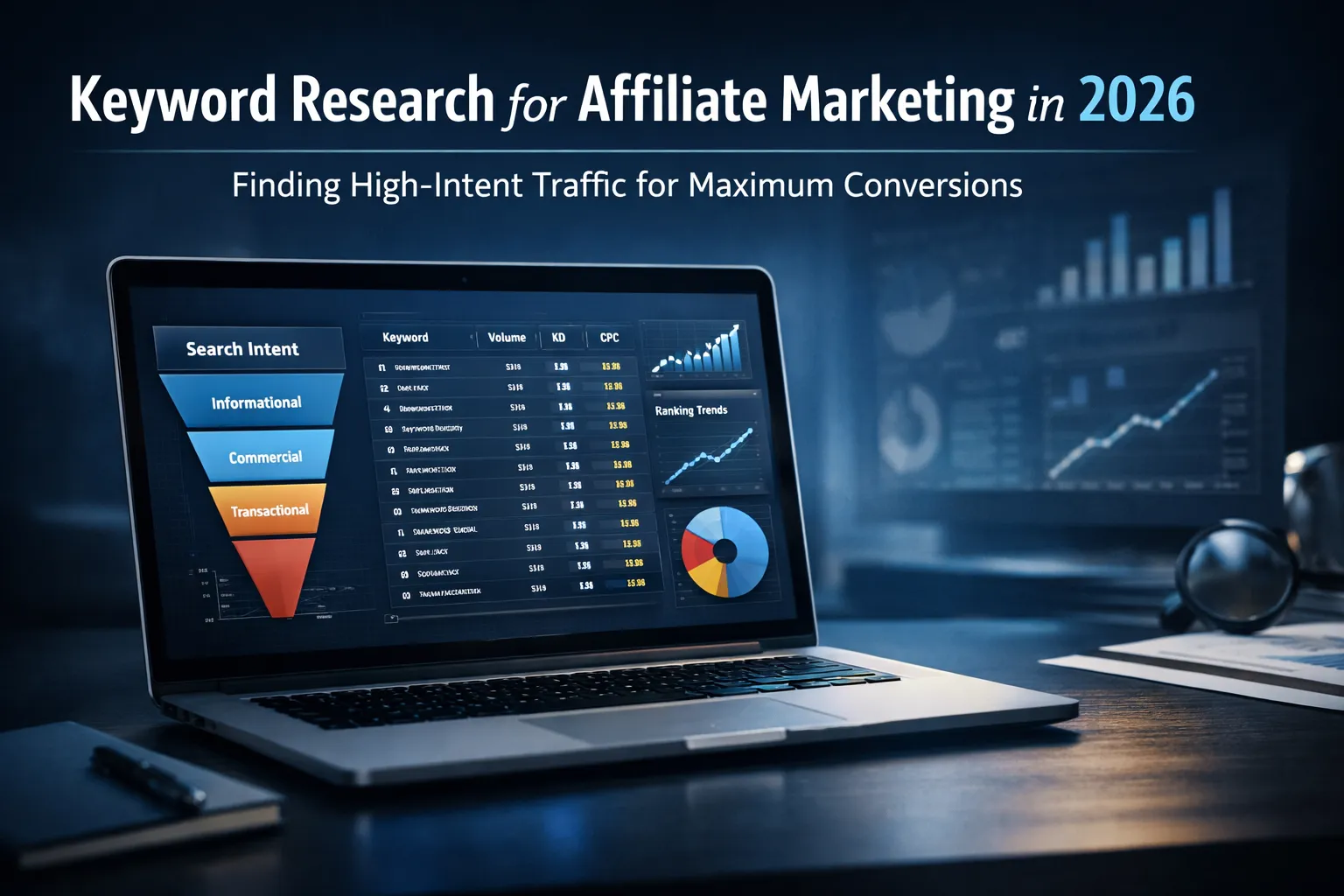
Affiliate marketing in 2026 is no longer a traffic game. It is an intent game.
Thousands of visitors mean little if they are not searching with commercial purpose. Sustainable affiliate revenue is built on one foundational skill: strategic keyword research aligned with search intent, SERP behavior, and topical authority.
This guide explores keyword research from an educational and analytical perspective. Rather than focusing on shortcuts, it explains the frameworks, evaluation models, and structural thinking required to attract high-intent traffic that converts.
Why Keyword Research Determines Affiliate Success
In affiliate marketing, revenue is a function of three variables:
- Search intent
- Content alignment
- Trust and authority
Keyword research directly influences all three.
If you target broad informational terms, you may generate traffic but little revenue. If you target high-intent commercial queries with structured, authoritative content, even modest traffic can produce consistent commissions.
In 2026, search engines evaluate not only relevance but also depth, clarity of intent match, and site-wide topical authority. This means keyword selection must align with:
- Buyer psychology
- Funnel stage
- SERP structure
- Competitive landscape
Keyword research is therefore not a preliminary step. It is the strategic foundation of affiliate SEO.
Understanding Search Intent at a Deeper Level
Search intent categorization typically includes four types:
- Informational
- Navigational
- Commercial Investigation
- Transactional
For affiliate websites, the most valuable are commercial investigation and transactional queries.
Informational Intent
Example: “What is affiliate marketing?”
These queries sit at the top of the funnel. They build awareness and traffic but rarely convert directly. They are useful for authority building and internal linking, not immediate revenue.
Commercial Investigation
Example: “Best email marketing software for small business”
Users are comparing options. They are evaluating features, pricing, and reviews. This is where structured affiliate content performs best.
Transactional
Example: “Buy Bluehost hosting” or “Ahrefs pricing 2026”
Users are close to purchasing. These keywords convert at higher rates but may be more competitive.
In 2026, search engines increasingly align results with dominant intent. If a SERP is dominated by comparison articles, a thin product page will not rank. Intent alignment must match the dominant pattern in the results page.
The Strategic Role of Buyer Psychology
Keyword research should begin with understanding user mindset.
At different stages, users think differently:
- Awareness stage: seeking information
- Evaluation stage: comparing solutions
- Decision stage: ready to act
Affiliate marketers benefit most from evaluation and decision stages.
High-intent modifiers often include:
- Best
- Review
- Comparison
- Vs
- Alternatives
- Pricing
- Discount
- For beginners / for small business
However, not every “best” keyword is profitable. Profitability depends on competition, SERP structure, and monetization alignment.
Building a Structured Keyword Research Framework
A systematic approach improves accuracy and scalability.
Step 1: Define Monetizable Categories
Start with clear product or service categories relevant to your niche.
For example:
- Hosting platforms
- SEO tools
- AI software
- VPN services
- Productivity tools
Without monetizable categories, keyword research lacks direction.
Step 2: Expand Using Intent Modifiers
Combine core products with high-intent modifiers:
- Best + product
- Product + review
- Product + alternatives
- Product A vs Product B
- Product + pricing
This creates commercially viable keyword variations.
Step 3: Evaluate Search Volume and Difficulty
Volume alone is not decisive. Consider:
- Realistic ranking potential
- Domain authority
- Topical authority
- SERP composition
A keyword with 500 searches and moderate difficulty may be more valuable than one with 5,000 searches and intense competition.
Evaluating Keyword Difficulty the Right Way
Keyword difficulty metrics from tools provide estimates, but they are not absolute indicators.
A deeper evaluation includes:
1. SERP Authority Analysis
Examine:
- Are top results dominated by global brands?
- Are there smaller niche blogs ranking?
- Are results thin or comprehensive?
If smaller sites rank, opportunity exists.
2. Content Depth Comparison
Analyze:
- Word count
- Structure
- Use of comparison tables
- Coverage completeness
If top results lack depth, a well-structured article can compete.
3. Backlink Profile
High backlink counts increase difficulty. However, in 2026, topical authority and content quality can offset raw backlink numbers in certain niches.
SERP Analysis Model for 2026
Before writing any affiliate article, analyze the search results page:
- What format dominates? (Listicle, comparison, review)
- Are featured snippets present?
- Are product ads visible?
- Is there heavy brand presence?
SERP structure reveals Google’s interpretation of intent.
If the SERP shows:
- Multiple affiliate-style list articles
→ It is commercially aligned.
If it shows:
- Mostly educational blog posts
→ The keyword may lean informational.
Alignment between content format and SERP expectation is essential.
Long-Tail Keyword Strategy for Sustainable Growth
Long-tail keywords remain powerful in 2026.
Example:
Instead of targeting:
“Best SEO tools”
Target:
“Best SEO tools for affiliate marketers in 2026”
Long-tail keywords offer:
- Lower competition
- Clearer intent
- Higher conversion rates
They also support cluster building and topical authority.
Keyword Clustering and Topical Authority
Modern SEO rewards topic coverage, not isolated articles.
A cluster model includes:
- One pillar article
- Multiple supporting articles
For example:
Pillar:
SEO for Affiliate Marketing
Supporting articles:
- Keyword research strategy
- On-page optimization for affiliate sites
- Link building for affiliate blogs
- Affiliate content structure guide
Internal linking strengthens contextual relevance and signals authority.
Common Strategic Mistakes in Affiliate Keyword Research
- Chasing high-volume informational keywords
- Ignoring SERP analysis
- Copying competitor headlines without adding depth
- Writing shallow “top 10” lists without evaluation criteria
- Ignoring user trust signals
Affiliate SEO fails when content lacks analytical depth and clear differentiation.
Turning Keywords Into Revenue
Keyword selection alone does not generate commissions. Execution matters.
High-performing affiliate content typically includes:
- Clear evaluation criteria
- Balanced pros and cons
- Structured comparison tables
- Transparent disclosures
- Logical internal linking
Trust increases conversion. Authority sustains rankings.
A Long-Term Keyword Strategy Roadmap
A strategic 6-month approach may include:
Month 1–2:
Target lower competition, long-tail commercial keywords.
Month 3–4:
Expand into comparison articles and alternatives pages.
Month 5–6:
Publish comprehensive pillar guides and strengthen internal linking.
This layered approach builds authority gradually rather than relying on aggressive targeting of competitive terms.
The Relationship Between Keyword Research and Site Authority
Search engines increasingly evaluate:
- Topical consistency
- Content depth
- Structured internal linking
- User engagement signals
When keyword research aligns with a defined niche focus, authority compounds over time.
Fragmented keyword targeting weakens long-term ranking potential.
Conclusion
Keyword research for affiliate marketing in 2026 is not about generating traffic volume. It is about identifying high-intent opportunities aligned with buyer psychology, SERP behavior, and topical authority.
Strategic keyword selection:
- Increases ranking probability
- Improves conversion rates
- Builds long-term trust
- Supports scalable content systems
Affiliate success depends less on publishing frequency and more on publishing precision.
Mastering keyword research is therefore not optional. It is foundational.
Frequently Asked Questions
1. What are buyer-intent keywords in affiliate marketing?
Buyer-intent keywords are search terms used by individuals who are close to making a purchasing decision. These often include modifiers such as “best,” “review,” “comparison,” “pricing,” or “alternatives.” They typically convert better than purely informational queries.
2. How do I know if a keyword has commercial intent?
You can identify commercial intent by analyzing the search results page. If the results include comparison articles, product reviews, and affiliate-style list posts, the keyword likely has commercial value. The presence of product ads is also a strong indicator.
3. Are long-tail keywords better for affiliate marketing?
Long-tail keywords often have lower competition and clearer intent. While their search volume may be smaller, they typically generate higher conversion rates because they target specific user needs.
4. How many keywords should I target in one affiliate article?
A well-structured affiliate article should focus on one primary keyword and several semantically related secondary keywords. Avoid targeting unrelated keywords within the same article, as this can dilute topical focus.
5. Is search volume more important than keyword difficulty?
Search volume alone does not determine profitability. A keyword with moderate volume and lower competition can be more valuable than a high-volume keyword that is dominated by large authority websites.
6. How does keyword research support long-term authority?
Strategic keyword research allows you to build content clusters around a core topic. Over time, this strengthens topical authority, improves internal linking structure, and increases ranking potential across related queries.
SEO plays a crucial role in affiliate marketing success in 2026. Learn the latest SEO strategies that can boost your traffic and increase your affiliate earnings https://zdigitallevel.com/seo-for-affiliate-marketing-in-2026/
Great blog here! Also your site loads up fast! What web host are you using?
Can I get your affiliate link to your host? I wish my web site
loaded up as fast as yours lol