
Introduction: Why Most Beginner Affiliate Sites Never Rank
Every year, thousands of beginners launch affiliate niche websites.
Most of them fail — not because affiliate marketing doesn’t work, but because their websites lack structure.
They publish:
- Random keyword articles
- Unrelated product reviews
- High-competition content too early
- Thin comparison posts
Then they wait for rankings that never come.
In 2026, ranking is no longer about writing “more articles.” It is about building topical authority — demonstrating structured expertise around a defined subject.
This guide explains how beginners can implement a clear topical authority strategy to build a niche website that ranks sustainably.
No hype. No shortcuts. Just a structured system.
What Is Topical Authority?
Topical authority is the perceived depth, expertise, and structural coverage your website demonstrates around a specific subject.
Search engines no longer evaluate pages in isolation. They evaluate:
- How many related topics you cover
- How deeply you cover them
- How well they connect internally
- Whether your content aligns with search intent
If you publish one article about “best email marketing tools,” that is a page.
If you publish:
- What is email marketing
- Email marketing for beginners
- Best email tools for creators
- ConvertKit vs MailerLite comparison
- Email automation workflows explained
- Email marketing pricing breakdown
Now you are building authority around a topic.
That is the difference.
Topical authority is not volume. It is structured relevance.
Why Topical Authority Matters More in 2026
Search engines increasingly prioritize:
- Topic depth
- Intent alignment
- Structured internal linking
- Content ecosystems
Single “SEO optimized” articles struggle if they are not supported by surrounding content.
For beginner affiliate sites, topical authority is especially important because:
- You likely have low domain authority
- You lack strong backlinks initially
- You cannot compete on brand recognition
Structure becomes your competitive advantage.
Why Most Beginner Affiliate Sites Fail
Understanding mistakes helps prevent them.
1. Publishing Random Articles
Beginners often chase whatever keyword looks easy. The result:
- No thematic consistency
- No cluster structure
- No internal linking logic
Search engines cannot identify what your site specializes in.
2. Writing Only “Best Product” Posts
If your site only contains:
- Best X
- Top 10 Y
- Review Z
Without educational and supporting content, it appears thin and commercially aggressive.
Balanced ecosystems perform better.
3. Switching Niches Too Early
Authority compounds over time.
Switching topics every few months resets momentum.
4. Ignoring Internal Linking
Many beginners publish articles without linking them strategically.
Internal linking signals contextual relationships. Without it, authority fragments.
The Beginner Topical Authority Strategy Framework
Now we move into the core system.
This is the actionable blueprint.
Step 1: Choose a Focused, Monetizable Niche
Broad niches are difficult for beginners.
Instead of:
- Fitness
Choose:
- Home gym equipment for small apartments
Instead of:
- Technology
Choose:
- Productivity software for remote workers
Instead of:
- Finance
Choose:
- Budgeting apps for college students
A narrow niche helps:
- Build faster authority
- Target lower competition keywords
- Create clearer topic clusters
- Improve conversion relevance
Clarity beats scale at the beginning.
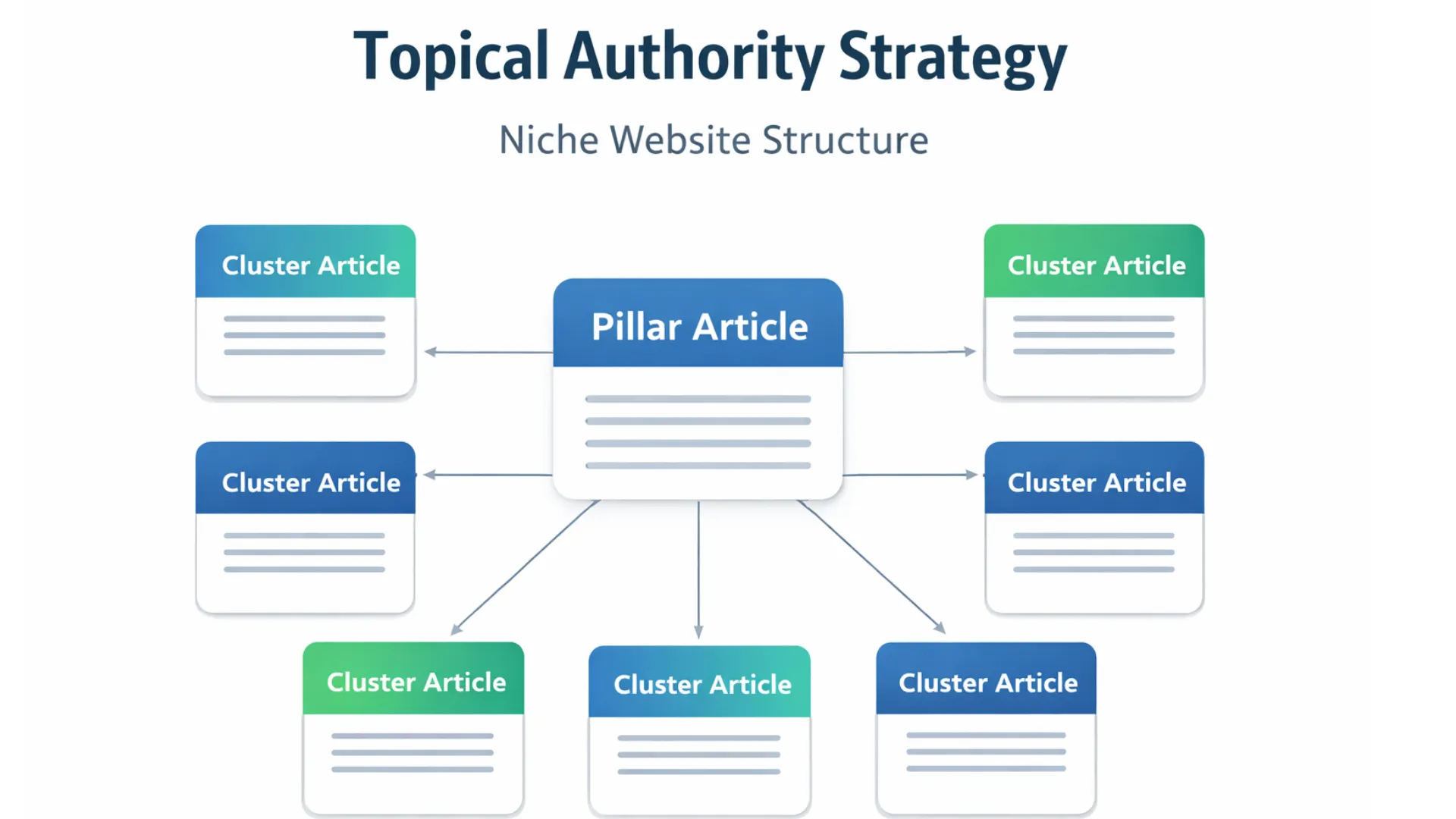
Step 2: Define Your Core Topic (Your Pillar)
Your pillar topic is the central theme your site revolves around.
Example:
If your niche is:
“Productivity tools for remote workers”
Your pillar topic could be:
“The Complete Guide to Productivity Tools for Remote Work”
This pillar article should:
- Introduce the main topic
- Cover key subtopics briefly
- Link to deeper supporting articles
- Serve as your authority anchor
It is not just a blog post. It is the structural center.
Step 3: Map Your Supporting Content Clusters
This is where topical authority takes shape.
From your pillar topic, create 5–10 supporting articles that expand specific subtopics.
Example cluster:
Pillar:
Complete Guide to Productivity Tools for Remote Workers
Supporting Articles:
- Best task management tools for remote teams
- Time tracking software comparison
- Focus apps for deep work
- Notion vs Trello for remote collaboration
- Productivity tool pricing comparison
- How to build a remote workflow system
Each supporting article must:
- Target one clear intent
- Cover the topic deeply
- Link back to the pillar
- Link to related cluster posts
This creates a structured network.
Step 4: Understand Search Intent Segmentation
Every cluster article must match one intent.
Avoid mixing:
- Informational
- Commercial
- Transactional
For example:
Informational:
“How does time tracking software work?”
Commercial:
“Best time tracking software for freelancers”
Transactional:
“Time tracking software pricing plans”
Intent clarity improves rankings and user satisfaction.
Step 5: Build a Clean Internal Linking Architecture
Internal linking is the structural glue of topical authority.
Best practices:
- Link from pillar → clusters
- Link from clusters → pillar
- Link related clusters to each other
- Use natural anchor text
- Avoid keyword stuffing
The goal is clarity, not manipulation.
Search engines follow internal links to understand topic relationships.
Step 6: Publish in Topic Bursts
Instead of publishing one article every two weeks randomly:
Publish 5–8 tightly related articles within a short timeframe.
This signals rapid topical expansion.
For beginners, this accelerates authority formation.
Step 7: Maintain Consistency for 6 Months
Authority builds over time.
A realistic beginner roadmap:
Month 1:
- Research niche
- Define pillar
- Map clusters
Month 2–3:
- Publish pillar
- Publish first 5 cluster articles
Month 4–5:
- Add 5 more supporting posts
- Improve internal linking
Month 6:
- Update articles
- Expand into adjacent subtopics
Consistency beats intensity.
How to Scale Topical Authority Over 12 Months
After initial clusters are built:
- Expand deeper subtopics
- Create comparison posts
- Add alternatives articles
- Strengthen informational support
- Update existing content regularly
Avoid expanding into unrelated niches too quickly.
Depth before breadth.
Common Beginner Mistakes in Topical Authority
Writing Thin Content
Covering topics superficially weakens authority.
Each article should answer:
- What
- Why
- How
- When
- Common mistakes
Over-Optimizing Keywords
Authority comes from clarity and depth, not repetition.
Ignoring User Experience
Poor formatting, long paragraphs, no structure → lower engagement.
Readable content supports authority perception.
Publishing 50 Unrelated Articles
More posts do not equal more authority.
Relevance and structure matter more.
How Topical Authority Supports Affiliate Conversions
Topical authority improves:
- Rankings
- Trust
- User time on site
- Repeat visits
When users see:
- Multiple related articles
- Clear structure
- Balanced information
They are more likely to trust your recommendations.
Trust increases conversions.
The Long-Term Mindset Shift
Topical authority strategy requires patience.
Affiliate beginners often expect results in weeks.
Realistically:
- 3–6 months for traction
- 6–12 months for meaningful growth
Authority is engineered through structure and consistency.
Final Thoughts
In 2026, building a niche website that ranks requires more than targeting isolated keywords.
It requires:
- Focused niche selection
- Structured pillar and cluster mapping
- Clear search intent alignment
- Strategic internal linking
- Consistent publishing
Topical authority is not accidental.
It is designed.
If you approach your affiliate niche website as a knowledge system rather than a collection of posts, rankings follow naturally over time.
FAQ Section (Visible Content)
What is topical authority in affiliate marketing?
Topical authority in affiliate marketing means creating a group of highly related content pieces around one niche topic so search engines recognize your site as a trusted resource.
How many articles do I need to build topical authority?
Most beginner niche sites can start building authority with 10–20 tightly related articles focused on one core topic before expanding further.
Is topical authority more important than backlinks in 2026?
Topical authority and backlinks work together. However, well-structured topical coverage allows new affiliate sites to rank even before acquiring many backlinks.
How long does it take to see results from topical authority?
Most niche websites begin seeing ranking improvements within 3–6 months when content is structured properly and published consistently.
Effective keyword research can make or break your affiliate marketing efforts in 2026. Discover proven techniques to find the best keywords and boost your traffic https://zdigitallevel.com/keyword-research-for-affiliate-marketing-in-2026/