
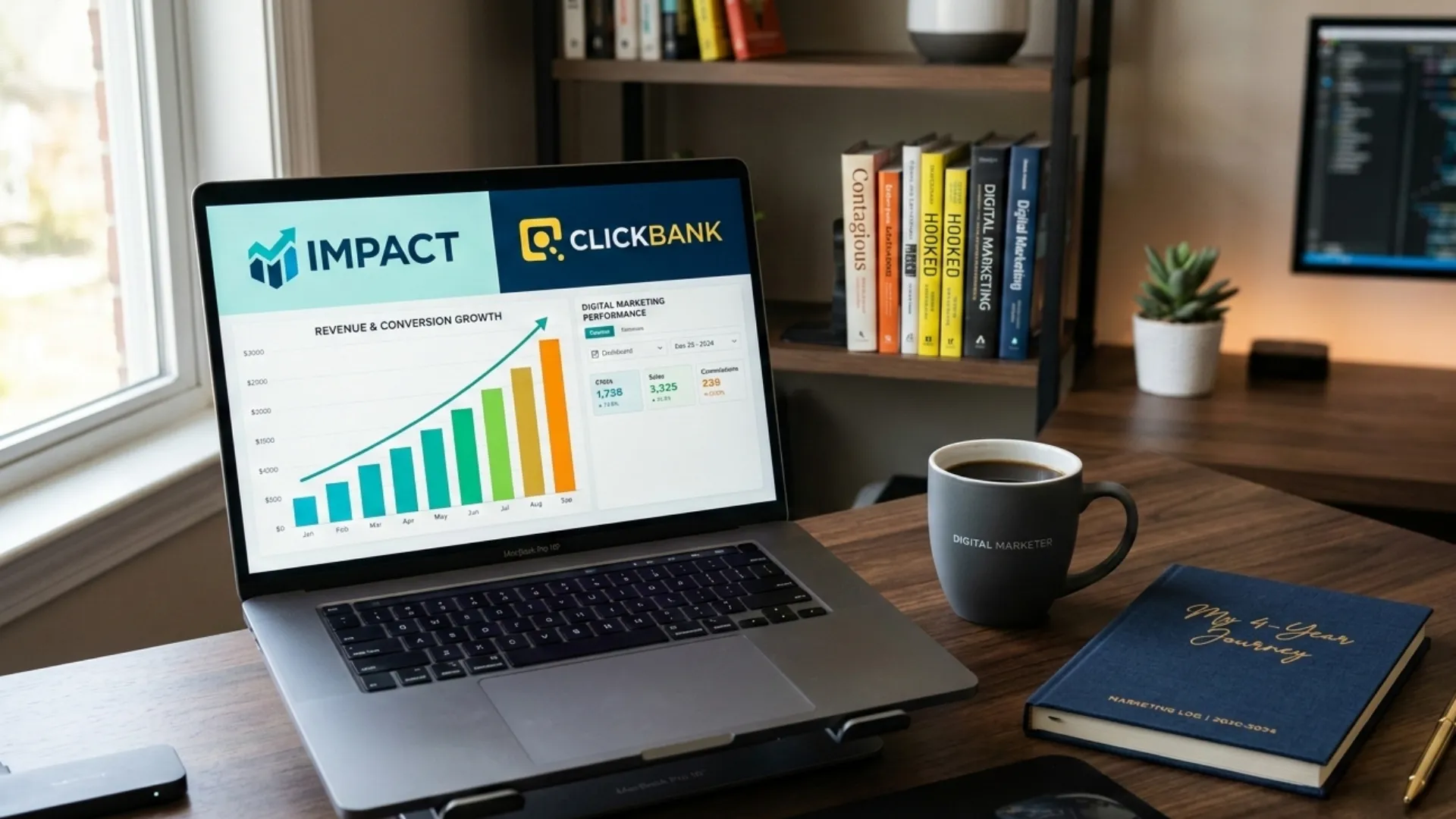
Introduction: The Illusion of “Easy Money”
Four years ago, I embarked on a journey that I thought would be a quick sprint to financial freedom. Like many beginners in the digital marketing world, I was lured by the promise of passive income, tropical lifestyle photos, and the idea of making money while I slept. I started with a laptop, an internet connection, and a head full of dreams.
However, the reality of Affiliate Marketing in the years leading up to 2026 was far from the “push-button” success many gurus advertise. My journey has been defined by late nights, technical headaches, and, most prominently, a soul-crushing wall of rejections. Today, I stand as a partner with global giants like Impact and Clickbank, but the road here was paved with failures that taught me more than any course ever could.
Phase 1: The Dark Days of Constant Rejection
When I first started, I didn’t have a strategy. I thought affiliate marketing was simply about grabbing a link and pasting it across social media or a basic blog. I applied to high-tier networks immediately, expecting them to welcome me with open arms.
The Rejection Cycle
I remember the first time I applied to a major program on Impact.com. Twenty-four hours later, I received the dreaded automated email: “Unfortunately, your application has been declined.” I tried again with a different brand. Rejected. I tried a third time. Rejected.
At that time, I didn’t understand that these companies weren’t just looking for “promoters”—they were looking for established digital real estate. My website was what Google calls “Thin Content.” I had 500-word articles that provided no real value, no original images, and a layout that looked like a scam site from 2010.
The Pain of Being “Invisible”: The rejections weren’t just from networks; they were from search engines too. I would check my Google Search Console daily, only to see a flat line. Zero impressions. Zero clicks. I was shouting into a void, and the void wasn’t answering back.
Phase 2: The SEO Nightmare and the “Aha!” Moment
My biggest hurdle during the first two years was SEO (Search Engine Optimization). I mistakenly believed that SEO was a “trick” you played on Google. I would “keyword stuff” my articles, mentioning “Affiliate Marketing” fifty times in a single post, hoping the algorithm would notice me.
Facing the Technical Wall
As a beginner, the technical side of SEO felt like learning a foreign language. I struggled with:
- Site Speed: My website took 7 seconds to load. I didn’t know how to compress images or use a CDN.
- Mobile Optimization: My site looked broken on smartphones, which is where 80% of my potential audience was.
- Indexing Issues: Half of my pages weren’t even showing up on Google because of “Crawl Errors.”
The Turning Point
The change happened when I stopped writing for robots and started writing for Humans. I realized that Google’s mission is to provide the “Best Answer” to a user’s question. If my article didn’t solve a problem, it didn’t deserve to rank.
I began a rigorous process of Technical SEO Audit. I switched to a lightweight theme, optimized my Core Web Vitals, and learned the art of Search Intent. I stopped targeting broad terms like “Make Money Online” and started targeting “Long-tail Keywords” like “How to get approved by Impact as a beginner blogger.” Suddenly, the flat line in my Search Console began to tick upward.
Phase 3: Mastering Clickbank and the Art of the Review
Once I understood SEO, I turned my attention to Clickbank. Clickbank is a different beast; it’s a marketplace filled with digital products where the competition is cutthroat.
From “Spamming” to “Consulting”
Early on, I would write “Best Product Review” without ever seeing the product. I was just copying the sales page. Unsurprisingly, I made $0.
I changed my approach to High-Value Reviews. I started:
- Analyzing Gravity Scores: Learning which products were actually selling and which had high refund rates.
- Creating Comparison Guides: Instead of one review, I compared three products. For example, “Product A vs. Product B: Which is better for Digital Marketers?”
- Adding Value-Added Bonuses: I told my readers that if they bought through my link, I would give them a free SEO checklist I created. This shifted me from being a “salesman” to a “trusted advisor.”
The first time I saw a “sale” notification in my Clickbank dashboard was a moment I will never forget. It wasn’t about the $20 commission; it was the proof that my system worked.
Phase 4: Scaling on Impact – Building Brand Relationships
By my third year, I was ready to revisit Impact.com. But this time, I didn’t go in empty-handed. I had zdigitallevel.com, a site with clean SEO, organic traffic, and high-quality content.
The Professional Pivot
Impact is where the “big brands” live (Canva, Adobe, Namecheap). These brands care about their reputation. To get approved, I had to demonstrate E-E-A-T (Experience, Expertise, Authoritativeness, and Trustworthiness).
I learned how to write “Application Letters” that stood out. Instead of saying “Please approve me,” I said: “I have a tech-focused audience of 2,000 monthly visitors who are actively looking for software solutions. My site ranks in the top 3 for [Keyword], and I believe your brand would provide immense value to my readers.”
The approvals started rolling in. I wasn’t just an affiliate anymore; I was a Brand Partner.
Phase 5: Why I Love This Career (The 2026 Perspective)
Looking back over these 4 years, I realized that my love for Affiliate Marketing isn’t just about the money—it’s about the freedom and the challenge.
- The Scalability: In a 9-to-5 job, you get paid for your hours. In affiliate marketing, a single article I wrote two years ago is still generating commissions today. That is the true power of “Passive Income.”
- The Tech Evolution: We are in 2026. AI has changed how we research, but it hasn’t changed the human need for trust. Being a human who shares real struggles (like my rejections) is my biggest competitive advantage against AI-generated “thin” content.
- The Ownership: I own my platform. I own my audience. I am not at the mercy of a single employer.
Crucial Lessons for the New Affiliate (My Advice to You)
If you are reading this and feeling discouraged by “Low Value Content” errors or network rejections, here is what 4 years of “blood, sweat, and SEO” has taught me:
1. Quality Over Quantity (Always)
One 2,500-word article that is the “Ultimate Guide” on a topic will out-earn a hundred 500-word “junk” posts. Google wants depth. If you are writing about a tool, show screenshots, explain the pros and cons, and talk about your personal experience.
2. Don’t Ignore the Boring Stuff
Technical SEO is boring. Setting up Privacy Policies and About Us pages is boring. But these are the signals that tell AdSense and Affiliate Networks that you are a legitimate business. Do the boring work first.
3. Build Your “Digital Fingerprint”
Don’t just copy what others are doing. Use your name. Share your specific story. Use your own photos. This unique “human” element is what makes your content High Value.
Frequently Asked Questions (FAQ)
Q1: Is it too late to start Affiliate Marketing in 2026? Absolutely not. While the competition is higher, the number of people buying online has doubled. The key is to find a specific “Niche” and become the most helpful person in that space.
Q2: How do I handle a rejection from an affiliate network? Don’t take it personally. Improve your site’s design, add 5 more high-quality articles, increase your organic traffic, and re-apply in 30 days. Persistence is the only way through.
Q3: Which is better: Clickbank or Impact? Clickbank is better for beginners who want to practice direct-response marketing. Impact is better for established bloggers who want to build long-term relationships with famous brands. I recommend using both to diversify your income.
Q4: How do I avoid the “Low Value Content” error from Google AdSense? Ensure every post you write provides a unique perspective. Don’t just summarize what’s already on the internet. Add your own data, your own screenshots, and your own expert opinion.
Conclusion: The Journey Never Ends
My 4-year journey from being a rejected beginner to a successful partner on Impact and Clickbank has taught me that the only way to fail in this business is to quit. The SEO will be hard, the rejections will hurt, and the technical glitches will frustrate you.
But on the other side of those challenges is a career that offers unparalleled freedom. At zdigitallevel.com, I am committed to sharing every lesson I’ve learned so that your journey can be faster and more successful than mine.
Building topical authority is one of the most important SEO strategies in 2026. By covering a topic in depth and connecting related content, your website can gain more trust and rank for many keywords over time https://zdigitallevel.com/how-to-build-topical-authority-in-2026/